
Identify a Miller County Property Owner in Three Records
Answering "who owns this property?" in Miller County takes a short cross-check, never a name copied off a single screen. Three offices hold the relevant material. The assessor, the Clerk of Superior Court, and the Tax Commissioner each keep property records for a different purpose. Keep their findings separate, then join them with the parcel ID and the legal description.
- Search the address through Miller County qPublic and capture the candidate parcel ID, owner display, situs, mailing address, and source date.
- Carry the parcel and legal-description clues to the GSCCCA real-estate index or the Clerk's grantor-grantee records.
- Open the newest ownership instrument and compare its grantee, property description, effective date, and prior references with the parcel card.
- Use the Tax Commissioner only for bill, balance, and taxpayer questions. Record any timing difference without treating the tax account as title proof.
This method also exposes lag in fresh transfers. A deed can be recorded first. The next tax digest has not appeared yet. The tax bill, meanwhile, may still list the account holder for its tax year. Comparing both dates prevents a mistaken conclusion about the current owner of record in Miller County property records.
Let the Miller Parcel ID Bridge Each Owner Search
Start with an address only when the parcel number is unknown. Addresses drift between systems. One database writes "S First" while another spells out "South First," and a Colquitt mailing label can even extend past the city limits. Let qPublic supply a candidate parcel ID. That number is the anchor. Pair it with the tax district, acreage, legal description, subdivision, lot, block, and deed reference, and false matches fade fast.
The Miller County qPublic landing page is the county's public assessment route. The direct Schneider application sometimes sits behind a security check. When the portal stalls, the Board of Tax Assessors at (229) 758-4100 can still assist, or you can visit Suite 106 at 155 S. First Street in Colquitt. A focused request for the existing parcel record works too. Clerks can pull it fast.
Explore the official qPublic parcel search here.
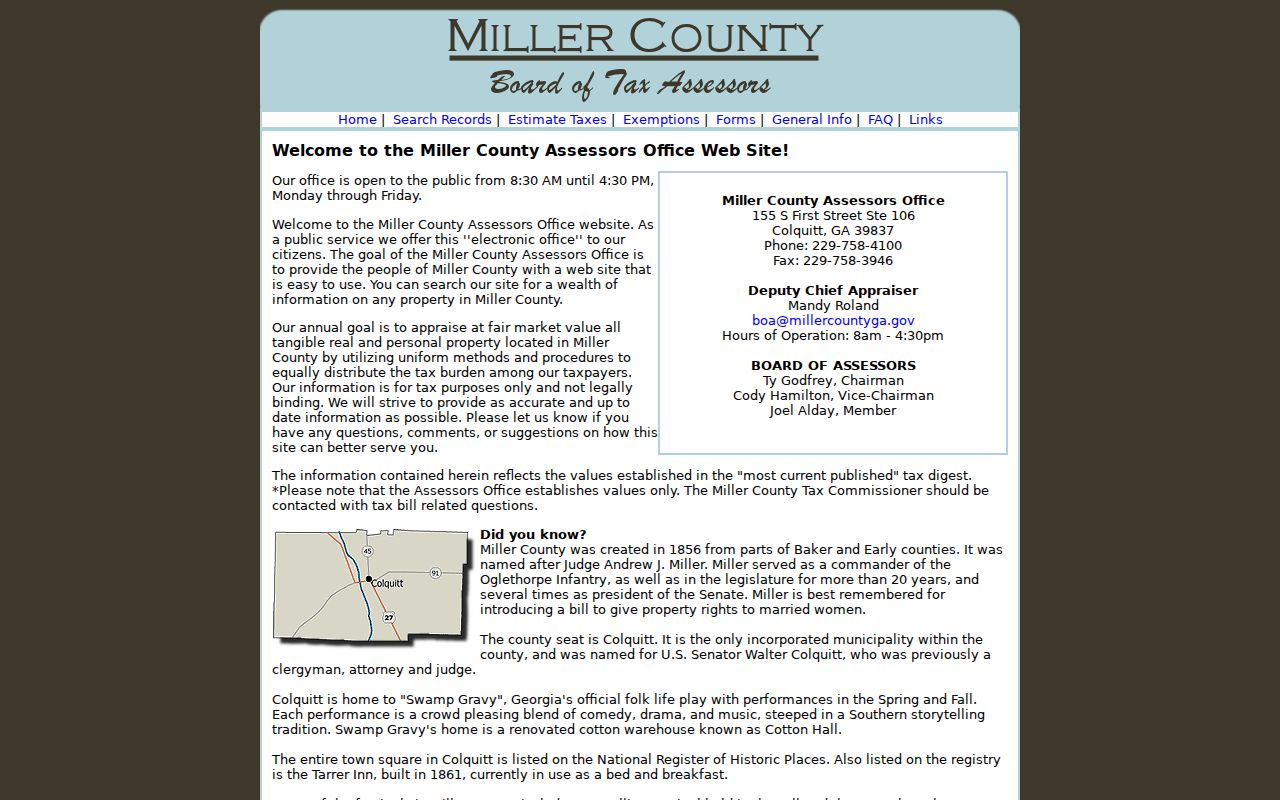
That assessor entry point is only the first stop on the ownership trail.
Read Miller County's Owner Display with Care
A qPublic owner display belongs to an assessment record. It may name the person or entity tied to the published tax digest. It is not a deed. It is not legally binding. Read the owner name alongside the parcel ID, situs, mailing address, tax district, legal description, acreage, sale history, and publication year. Keep the mailing address separate from the physical parcel, since owners and occupants often differ.
- Owner of record
- The name presented on a current public record for its stated purpose and date.
- Latest grantee
- The recipient named in the newest recorded instrument that conveys the tract.
- Situs address
- The physical address assigned to the property, which may differ from the owner's mail address.
- Vesting
- The way the recorded instrument states that ownership is held.
Record an "as of" date with every result. A stale display is a reason to pull the newest recorded instrument, not a reason to guess who holds title now.
Cross-Check Miller County Ownership Sources
Each custodian answers only one part of an owner question, and the table keeps those roles distinct.
| Ownership source | Fact to capture | Access route |
|---|---|---|
| Miller County qPublic | Displayed owner, parcel ID, situs, tax year | Web, assessor phone, or counter |
| Clerk or GSCCCA | Newest grantee, deed type, book/page, legal description | State index, local counter, phone, email, or mail |
| Tax Commissioner | Bill account, payment status, tax-year addressee | Payment portal, phone, or office |
| Probate Court | Estate authority and representative trail | Direct court request |
| Corporations Division | Entity status, control number, agent or officers | State business search |
Portal mechanics are covered in the Miller County property lookup. Here the goal is simpler: tie the parcel to the newest deed.
Trace the Miller Property to Its Latest Grantee
The Clerk records warranty deeds, quitclaim deeds, security deeds, assignments, rights-of-way, easements, plats, fi fas, and the related indexes. Search transfers separately from liens and loan documents. A security deed, assignment, or cancellation can change a lien chain without ever changing the property owner. Keep those chains distinct.
The GSCCCA real-estate index guide notes that all Georgia counties are indexed from at least January 1, 1999, with older records still being added. Search Miller County by party name and date range. Then open the image. Match the legal description, parties, signatures, parcel clues, and any later corrections. Basic and premium features differ, so the local counter remains the fallback.
The Clerk sits in Courthouse Room 103, 155 S. First Street, Colquitt. Reach the office at (229) 758-4102 or by email at gail.johnson@gsccca.org. Use the counter, phone, email, or mail whenever online access leaves the ownership question open.
Handle Miller Trusts, Estates, and Entity Owners
A deed may name a trust, an estate, a company, or several grantees at once. Copy the name and capacity exactly as written. The Georgia Corporations Division search can return entity status, a control number, the registered agent, officers, formation details, and annual-registration filings. Those fields help separate similar names. They still do not prove every beneficial interest behind the entity.
For an estate transfer, tie the death date and the Probate Court authority to the deed signed by the executor, administrator, or other representative. Miller Probate Court handles wills and estates. A probate order, though, is not always the final ownership instrument. Follow the trail until a recorded transfer names the grantee.
Match names carefully: Require two markers before accepting a match. Use the parcel description, instrument chain, entity number, address, or a unique date.
Do Not Mistake a Miller Tax Bill for Title
The Tax Commissioner bills and collects taxes on the assessed account, and that record can confirm a balance, a payment, a receipt, or the tax-year addressee. None of those facts proves ownership on its own. The owner may have sold recently. An agent may pay the bill. The digest and the deed index may also update on different schedules.
Miller's payment landing page links to AssuranceGov, while qPublic handles assessment and parcel information. For a dependable tax-status answer, contact the Tax Commissioner at (229) 758-4101 and read the current bill. Label that answer as a tax finding. It is not ownership evidence.
Stop When a Miller Owner Address Is Protected
Georgia Safe at Home lets eligible participants swap in a designated address. The substitute appears across state and local public records. VoteSafe works similarly for voter residence details. A masked or substituted address is not evidence that no owner record exists. Nor should it invite any attempt to locate the person behind it.
Work the question from the parcel side instead. Miller County property records can name the owner of record. The parcel number and the recorded deed can get you there without pulling in extra personal detail. Keep in mind what these records cannot show. They may not reveal an occupant, every member of a trust, or each person behind an entity. Title interests can look tangled. A qualified legal or title professional is the right next step in that case.
Recognize the Limits of “Who Owns This Property”
Every display answers only a narrow question. An assessor card, a tax bill, a ZIP label, and a map polygon each describe one slice of the parcel. None of them proves legal title, city limits, or a surveyed boundary on its own. Even the newest deed may need company. A correction, an estate file, a later conveyance, a lien release, or a quiet-title order can appear at any time. Each can change what the instrument really means. Where a gap stays open, label it rather than passing off an inference as fact.
Use owner records lawfully. Ownership searches support purchase research, estate work, boundary questions, and civic review. Never use a record to stalk, harass, target, or defeat an address-protection program.
For a present-tense snapshot, the Miller County current owner lookup carries the parcel forward. A full title opinion sits beyond what these public displays can give.