
Build a Miller County Deed-Chain Timeline
Build the timeline one transfer per row. The newest deed names the first prior owner. Each grantor's own acquiring deed supplies the next line back. Label dates and coverage precisely, because online availability does not mark where the county's records begin.
| Transfer date | Grantor to grantee | Deed type | Book, page, or source |
|---|---|---|---|
| Newest verified date | Current deed's named parties | Warranty, quitclaim, estate, or other conveyance | GSCCCA image or Clerk record |
| Prior verified date | Earlier owner to newest deed's grantor | Read from the instrument | Prior reference or name search |
| Earlier book era | Parties copied from the deed book | Classify only after reading | Clerk volume or Archives microfilm |
| Context-only year | Name found on a tax digest or notice | Not a deed transfer | Digest, probate, plat, or newspaper citation |
A tax listing or lien entry is not a transfer. Keep verified former owners separate from supporting leads, and flag every missing link in the Miller County chain.
Walk Miller County's Ownership Chain Backward
Start with the latest recorded conveyance for the exact parcel. Match the land, not the name. Searching a grantor across a date range is sound practice, but a shared rural surname never proves two records involve the same person.
- Find the newest deed and record the grantee, grantor, deed type, dates, book/page, and full legal-description clues.
- Treat that grantor as the next former-owner candidate, then search for the deed where the same party was grantee.
- Confirm the same tract through land lot, district, subdivision, lot, block, acreage, boundaries, parcel references, and prior instrument.
- Repeat one conveyance at a time, checking later corrections and noting parcel splits, merges, and “less and except” terms.
- When the online run ends, continue through Clerk volumes, microfilm finding aids, plats, tax digests, and probate records.
- Grantor
- The party conveying an interest in a deed.
- Grantee
- The party receiving the interest stated in that instrument.
- Chain of title
- The ordered series of recorded conveyances for the same land.
- Reverse index
- An index arrangement used to find a deed through a grantee or other backward-search key.
- Quitclaim deed
- A conveyance of whatever interest the grantor has, without the warranty associated with a warranty deed.
Search Miller Grantors and Grantees Across Time
Georgia's statewide index is the workhorse for old deeds. The GSCCCA real-estate index guide notes that every county has online coverage from at least January 1, 1999, with older historical data still being added. Search modes cover names, property fields in participating counties, book and page, and premium instrument filters. Results can show parties, location, book/page, and linked images.
Run the exact name first. Then try spelling variants and wider dates. Inspect the image itself for legal description, stated consideration, signature and notary pages, exhibits, any prior instrument, and later releases or corrections. Basic and premium tools differ, and some images or advanced functions can require login or payment.
Online boundary: January 1, 1999 is the statewide minimum online index date, not the start of Miller County ownership records. Verify earlier digital coverage before assuming it exists.
Continue Miller County Former Owners at the Clerk
The Clerk of Superior Court keeps the county's deed records. Warranty and quitclaim deeds, plats, easements, rights-of-way, security deeds, assignments, and fi fas all pass through this office, along with the indexes. For earlier owners, ask for the grantor-grantee books. Also request the deed volume, any referenced plat, and instruments named inside the deed. The office is Courthouse Room 103, 155 S. First Street, Colquitt. The county lists (229) 758-4102, gail.johnson@gsccca.org, and weekday hours of 9:00 a.m. to 5:00 p.m.
Use the counter when you can. Phone works too. Email and mail requests are also options. State the party names, date range, book and page, subdivision or land description, and parcel ID for modern accounts. When a public file sits outside the index, Georgia's open-records route reaches existing documents and electronic data subject to exemptions. Staff need not create a new ownership report.
Find Miller's Older Deed Books and Tax Digests
Georgia Archives' Virtual Vault holds scanned county tax digests. It also holds Superior Court deed books, probate records, and related series. Its county-card collection shows record types and date ranges before you request anything or travel. No complete Miller deed-book inventory appears online. Check series and surviving dates with the Archives and Clerk. Browse the Georgia Archives tax and deed collection.
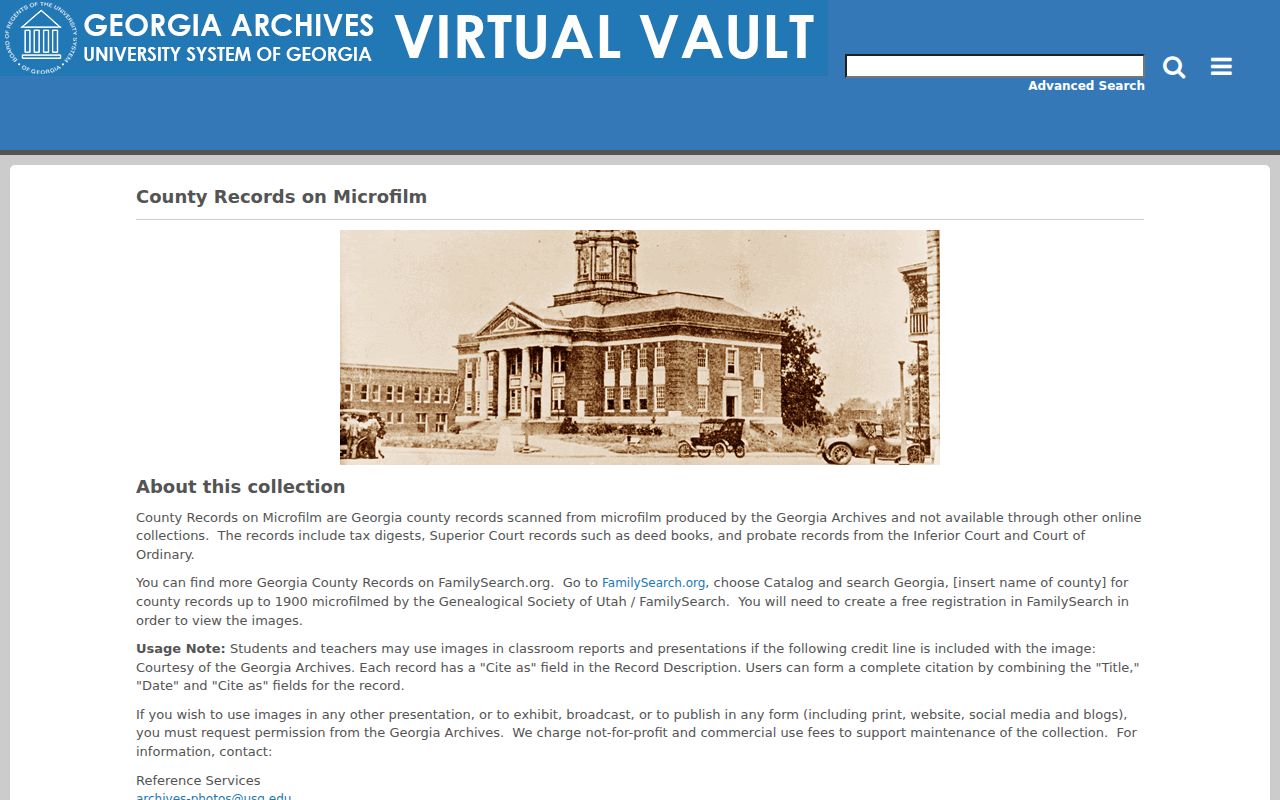
The collection takes the hunt beyond modern parcel systems. An old tax entry stays supporting evidence, though, until a deed confirms the property chain.
Account for Miller County's Courthouse Record History
Miller County dates to 1856. It was carved from parts of Early and Baker counties. Colquitt became the county seat that year. A chain reaching before county creation may continue in a parent county's deed books. The local history also records that the first courthouse was replaced. Courthouses burned twice before the present building was completed in 1977.
Fire does not prove loss. Ask the Clerk and Georgia Archives which originals survive. Copied books, reindexes, and microfilm may also cover the series and dates you need. The Georgia Archives county cards work well as a finding aid. Treat any break in the former-owner chain as unexplained. Confirm the volume history first.
Connect Miller Probate Transfers to Later Deeds
An owner may vanish from the sale pattern because the property passed through an estate. Miller Probate Court handles wills and estates. Track the death date, the will or administration, the personal representative, any sale authority, and the court order. The deed signed by an executor or administrator completes the story, since the probate file explains authority while the recorded instrument shows how the land moved.
Cemetery evidence helps when names collide. Colquitt City Cemetery lies southwest of the square, and the official inventory notes unmarked or unreadable graves along with a first known interment in 1838. A burial listing is not ownership proof. Use it as a person-date clue. Then verify the probate and deed records.
Use the Miller County Liberal as a Historical Index
The Miller County Liberal runs from 1897 through its current issues inside the Georgia Historic Newspapers archive. That range makes it a working index for old Miller County property records. Search former owners and their name variants. Pair those names with terms like deed, administrator, tax fi fa, legal notice, plat, road names, subdivision names, and cemetery names. OCR misreads print often. So save the page image, the issue date, and the exact notice whenever a hit looks promising.
One notice can surface an estate representative, a sale date, an older place name, or a full property description. Treat every find as a lead. Confirm it against the Clerk's recorded deed or an official court file. The paper shines brightest where modern addresses did not yet exist.
Trace Former Owners Through Miller Plats and Splits
Judge Drake Subdivision and Old Mill Acres both surface in dated Miller County planning material. Legacy appears there too. Search those names exactly. The Legacy file mentioned 25 acres and 49 homes. Old Mill Acres came up in a value discussion. Treat those figures as dated clues, not proof of current parcel boundaries or counts.
A parent tract often splits into several accounts. A later lot deed may cite the original plat rather than the current street address. Follow plat book and page references. Follow road dedications and acreage changes. Follow parent-child parcel IDs and “less and except” language. That keeps each former owner tied to the right land. The Miller County deed records stay honest about who held what.
Mark How Far Miller Ownership Records Truly Go
Deeds online, courthouse books, Archives microfilm, tax digests, probate files, and plats can all push the Miller County ownership chain further back. Newspaper notices can help too. The true endpoint depends on the exact tract and surviving series. Never plug a date from a finding aid into a missing conveyance. Older than 1856, Miller County did not yet exist. Look instead to Early or Baker County property records.
Use the past lawfully. Former-owner research supports title diligence, estate work, and house history. Do not use it to track, harass, or expose a living person.
For the current name on the parcel record, see the Miller County current owner page. A chain with unresolved interests or missing deeds may call for qualified title or legal research.