
Read Miller County Property Tax Records
Two offices split the tax record in Miller County. The Board of Tax Assessors sets values for tax purposes and keeps the assessment roll. The Tax Commissioner bills and collects. Read both records together, because neither one holds every answer.
| Field | What It Shows | Where |
|---|---|---|
| Fair market value | Tax-purpose estimate for the stated year | Assessor roll |
| Assessed value | Generally 40 percent of fair market value in Georgia | Assessor roll |
| Exemptions | Approved reductions affecting taxable value | Assessor record |
| Bill and status | Original tax, payments, additions, and balance | Tax Commissioner |
| Tax district | Applicable government and levy context | Assessment and bill |
Never treat the bill as a sale appraisal or an asking price. It does not prove what a buyer would pay. Match the parcel and the tax year before comparing any value.
Assessor and Tax Commissioner Split the Work
The Miller County Board of Tax Assessors handles valuation, parcel characteristics, assessment-stage exemptions, and notices. The office works from 155 S. First Street, Suite 106, Colquitt, at (229) 758-4100. The Tax Commissioner covers billing, collection, payment questions, mobile homes, timber, and related functions. Route value, classification, acreage, and exemption questions to the assessor. Route balance, receipt, penalty, and payment questions to the Tax Commissioner. When researching a recorded fi fa or lien, add the Clerk's deed records too.
Translate the Miller Tax Values
Four essential tax terms
The terms repeat on every Miller County tax record. Fair market value is the assessor's tax-purpose estimate. Assessed value generally runs 40 percent of that figure. An exemption shrinks the taxable base once approved, and one mill equals one dollar of tax per thousand dollars of taxable value.
Compare land, improvements, total value, exemptions, tax district, and physical traits across several years. A changed total can come from revaluation, new construction, corrected acreage, a classification shift, or an exemption change.
Look Up a Miller County Tax Bill
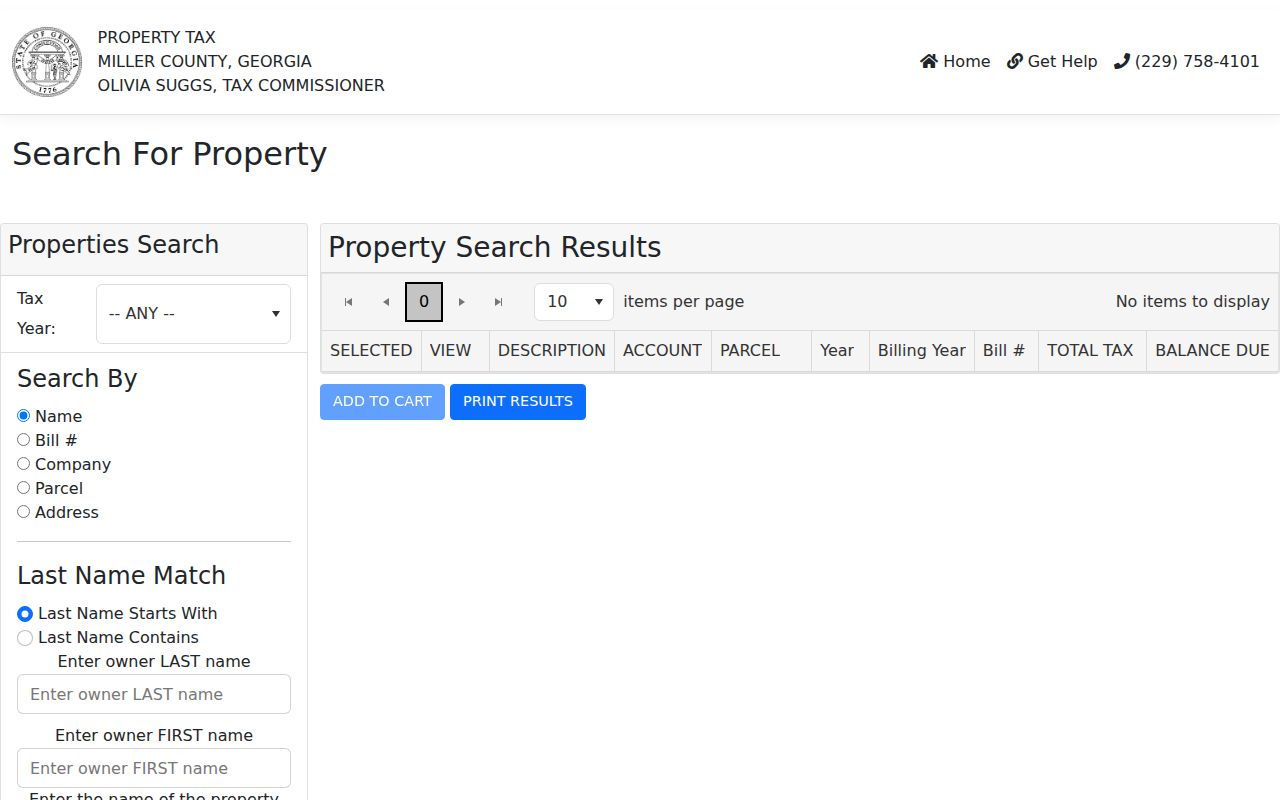
Start with the parcel ID from qPublic. Then follow the county's payment route to Miller AssuranceGov. The portal's search fields and convenience fees can change, so read the current screen and verify the domain through the county site.
- Find the parcel by address or owner and copy its identifier.
- Select the correct tax year in the linked payment system.
- Compare owner, situs, tax district, exemptions, payments, and balance.
- Ask the Tax Commissioner for a receipt or payoff when status is unclear.
- Assessed value
- The tax base before applicable exemptions.
- Mill rate / levy
- The rate applied to taxable value.
- Homestead exemption
- Relief tied to approved ownership and occupancy.
- Tax lien
- A recorded claim for unpaid tax, not a completed sale.
The official payment portal captured for the manifest shows the linked Miller experience.
Use the Tax Commissioner for a time-sensitive or certified balance.
Use Miller's 2021-2025 Digest History
The county's tax digest and five-year history page posts 2021 through 2025 material. It explains the overall tax base and millage process. It is not a parcel-price index. For an individual trend, return to annual parcel records. County minutes also report a countywide reevaluation completed in 2023, with more market-driven updates in 2024. Those dated discussions give context, not a current parcel value or any 2026 policy statement.
Resolve the December 20 Conflict
A current local FAQ states a December 20 due date. It also lists monthly interest and a penalty within 90 days. An older county page gives different timing and formula language. The conflict is real. Follow the current bill, and request a balance as of your payment date. The tax landing page even contains stray Mobile County wording. Its contact and payment route stay Miller-specific, though. That is one more reason to verify through the official county link.
Note: A tax fi fa does not by itself prove that a tax sale occurred or that ownership changed.
Apply for Miller Homestead Relief
Georgia DOR guidance says an applicant generally must own and occupy the home on January 1 and file by April 1 for that tax year. Confirm Miller forms, evidence, and any senior program with the assessor. The qPublic forms page carries other-county template text. Bring ownership evidence, parcel information, identification, and whatever eligibility documents the office requests. Remember that transfers and changes in occupancy or use can affect an exemption.
Appeal a Miller County Assessment
An assessment appeal challenges value, taxability, or uniformity. It is not a bill-payment dispute. Georgia allows 45 days from the annual notice. Submit to the Board of Tax Assessors and keep proof of filing. Strong evidence includes the notice, parcel card, photographs, measurements, condition, qualified sales comparisons, and examples of inconsistent treatment, and the PT-311A page explains the state form and county route.
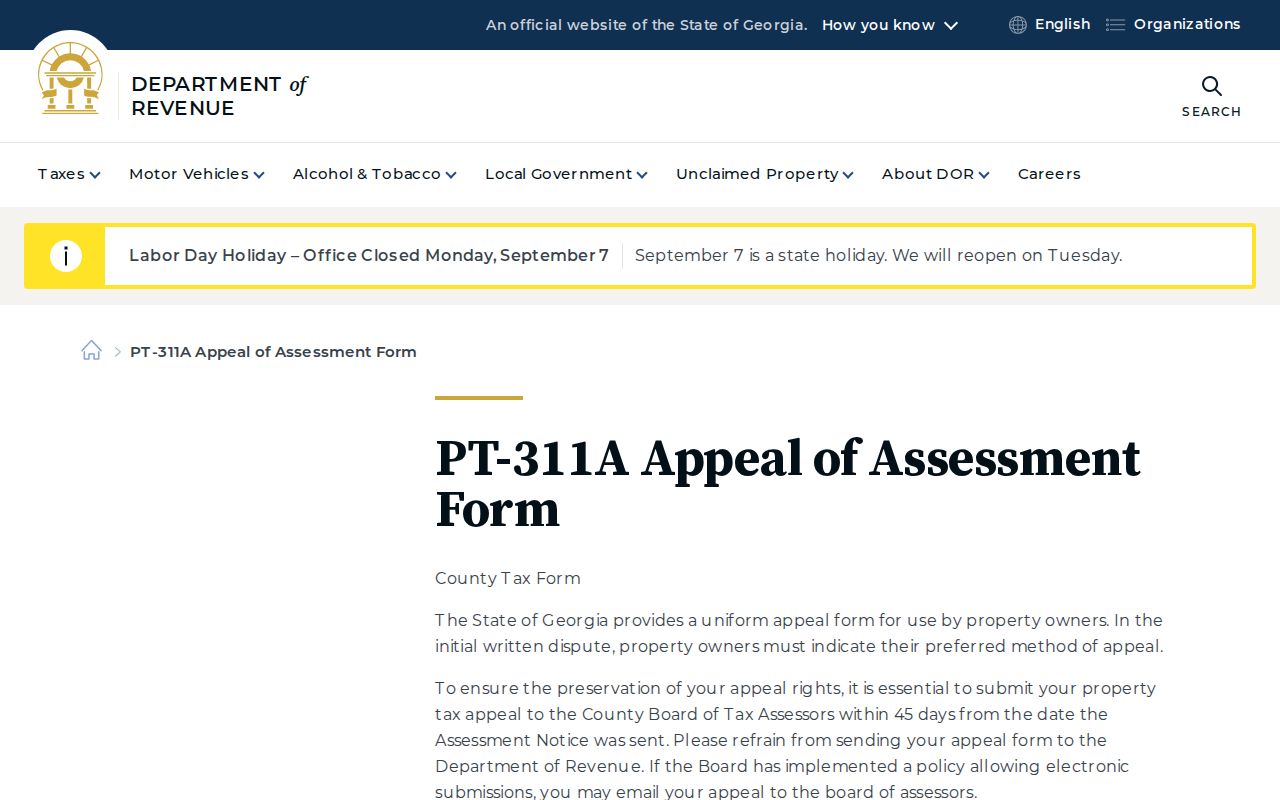
Follow your selected Board of Equalization or arbitration route where it applies, and preserve every notice.
Appeal window. File within 45 days of the annual notice using its printed deadline, and contact the assessor immediately if timing is uncertain.
Request Missing Miller Tax Records
When a portal falls short, give the responsible office the parcel ID, situs, owner name, tax year, and the exact record you need. Ask separately for an assessment card. Ask for an annual notice, exemption status, bill, or payment history. A receipt, delinquency calculation, or lien reference can be requested too. Be specific. Vague requests slow things down. For county administrative material, the open-records form notes a three-day response process under the Georgia Open Records Act. Constitutional-office requests go straight to the office holding the record. A response may return an estimate and production schedule instead of immediate access.
Follow a Delinquent Miller Account Carefully
A delinquent balance can trigger interest, penalty, collection activity, and a recorded tax fi fa. Those are stages, not synonyms. Start with the Tax Commissioner for the account balance and status. Then search the Clerk's recorded lien material by owner and parcel description. If a tax sale is alleged, request the advertisement, levy, and sale documentation. Request the deed and any redemption-related record too. Do not infer a completed sale from one lien entry.
Public notices can help identify an advertisement date. The Miller County Liberal can help with a party spelling. They stay leads until matched to the official tax and recording files. A later payment portal balance also does not show whether a recorded lien was cancelled. So trace the release reference through the deed records.
Compare Like Miller Parcels in an Appeal
Strong uniformity evidence starts with parcels that truly resemble each other. Match location, land use, acreage, building type, age, condition, and tax district. Do this before you rely on any comparison. A Colquitt residential lot tells you little about a rural agricultural tract. So keep the two groups apart. Neighborhood and utility context can sway an appeal too. That point comes through in county discussions of Old Mill Acres, the Legacy subdivision, and city development. Still, current parcel facts and qualified sales evidence carry the argument.
Work through the parcel record field by field. A wrong square footage, acreage, improvement grade, exemption, or land classification gives you something concrete to fix. That beats a vague claim that the tax bill feels too high. Photograph the conditions. Date each piece of evidence. Tie every item to the issue on appeal.
Keep the Tax Year Attached to Every Figure
Every document in the tax cycle serves a different stage. An annual notice, parcel card, digest, bill, and receipt can each show a different figure. A delinquency calculation can differ too. Label every value you save with its year and its source. When two years diverge, check first whether the land, improvements, exemptions, tax district, acreage, or physical record changed. Don't assume a market increase caused the gap.
Keep disputes organized by type. A payment dispute calls for the bill, confirmation number, receipt, and office correspondence. A valuation dispute instead hinges on the annual notice. It also hinges on whatever evidence you filed inside the appeal window. Separating those tracks keeps a later request specific and easy to reproduce.