
What Miller County Deed Records Show
Deeds, security deeds, liens, plats, and UCC material all pass through the Clerk of Superior Court in Miller County. Related real-estate instruments do too. Pull up a deed image and you get plenty. It names the parties, shows execution and recording details, and spells out the consideration language. The legal description sits there too, along with any reservations, exceptions, and prior references. Keep the deed type in mind. What the document accomplished depends entirely on which instrument was filed.
| Deed Type | What It Does | Common Use |
|---|---|---|
| Warranty deed | Conveys title with broad covenants | Conventional conveyances |
| Quitclaim deed | Conveys only the grantor’s interest | Interest transfers and title corrections |
| Limited or special warranty | Conveys with narrower promises | Transactions using limited covenants |
| Trustee / executor deed | Conveyance by an authorized fiduciary | Estates, trusts, and fiduciary sales |
| Tax deed | Recorded conveyance following a tax sale | Tax-sale chain research |
A warranty deed or a quitclaim deed conveys an interest. A security deed, by contrast, secures debt, and a cancellation or release clears that lien. All of these share one index. So read the instrument type and the legal description. Do this before treating an entry as an ownership transfer.
Reach the Miller Recorder in Two Ways
The Miller County Clerk of Superior Court is the authoritative local office. It sits at Courthouse Room 103, 155 S. First Street, Colquitt, GA 39837, telephone (229) 758-4102. The online route is the GSCCCA real-estate search. It indexes Georgia county filings. It may provide document images under its access terms. The GSCCCA site presents the statewide search choices. These lead into the real-estate, lien, plat, and related systems.
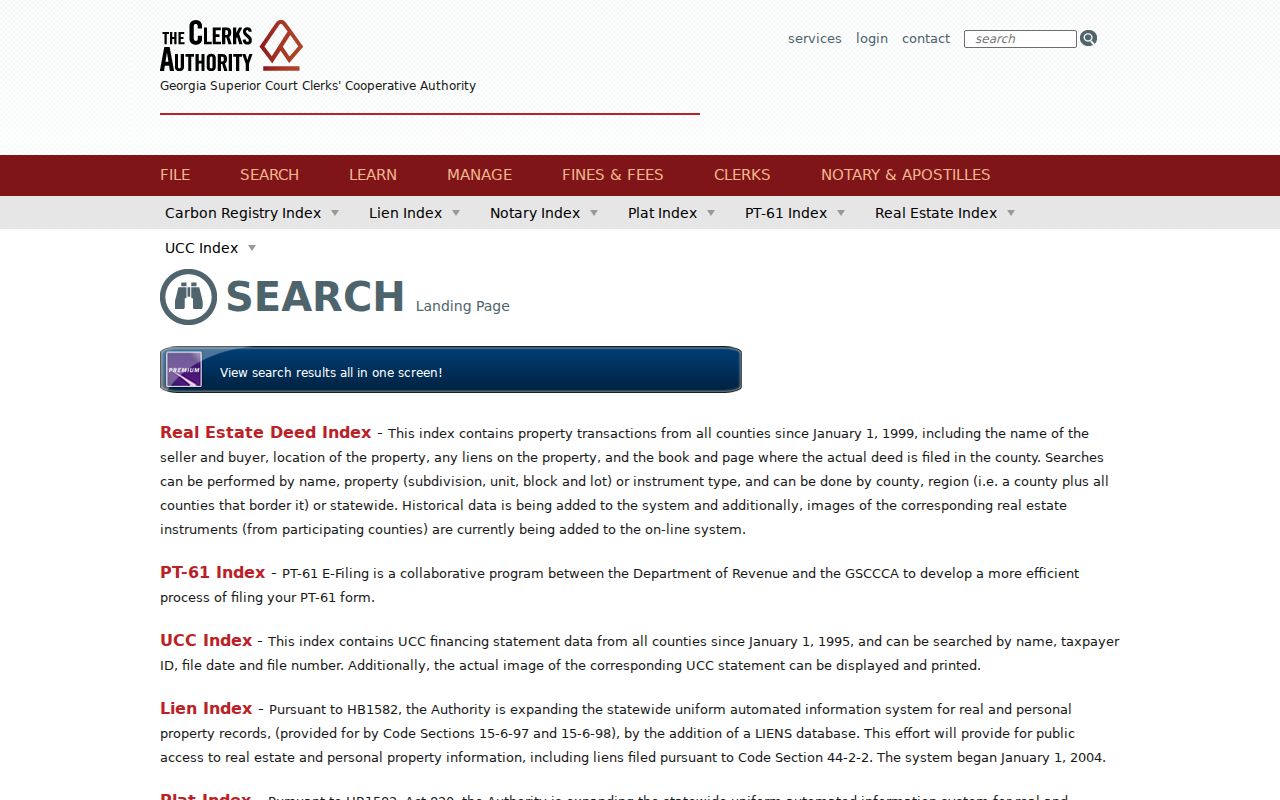
Select Miller County first, before you type any party name or date range. Save each book/page or instrument number the results return. Those references are your way back to the recorded deed.
Search Miller Grantors and Grantees Carefully
Start with the grantee on any acquisition you already know about. The grantee is the one who received the interest. Then search that same person or entity as grantor. This catches a later conveyance out of the property. To work backward, flip the method. Take the current grantee, find that deed's grantor, then chase the grantor's earlier acquisition. If the chain breaks, widen the date range and try name variants.
| Field | How to use it | Check against |
|---|---|---|
| Party | Try individual and entity variants | Signature and vesting language |
| Role | Separate grantor from grantee | Deed's granting clause |
| Date | Search near the known transfer | Execution and recording dates |
| Instrument type | Isolate conveyances from liens | Full recorded image |
| Book/page or number | Preserve retrieval key | Clerk's record |
Common surnames need extra care.
Use the legal description, acreage, prior-deed reference, and parcel context to keep unrelated chains apart.
Decode Miller County's Deed Index
An index entry is only a finding aid, not the deed itself. Copy down the county and the parties. Record their roles and the document type. Include the recording date, the book and page, the instrument number, and any image reference. Then open the image itself. That is where the legal description lives, along with any citation to a prior deed. Together these fields carry you backward or forward through the deed records. So you need not assume a street address stayed the same over the years.
- Find the current owner's acquisition deed with that owner indexed as grantee.
- Read the grantor and the prior-deed reference from the recorded image.
- Search that grantor as grantee in an earlier period and compare the land description.
- Repeat until the online trail ends, then request the corresponding deed books or microfilm.
- Grantor
- The party conveying the interest.
- Grantee
- The party receiving the interest.
- Chain of title
- The linked sequence of recorded conveyances for the same land.
- Book/Page vs Instrument #
- Either can be the Clerk's retrieval key; record every reference the index supplies.
Let the Legal Description Control the Match
Miller County deeds describe land in several ways. A tract may appear by lot and block, by subdivision and plat, by metes and bounds, by acreage, or by land lot, district, or GMD, often with exceptions and easements attached. A street address is handy. It is not the legal description. Compare every repeated tract clue, especially when a parcel was split, merged, or conveyed as part of a larger tract.
Recorded plats can settle questions about subdivision lots, roads, access, and cited dimensions. A tax map helps you get oriented, but it serves a different purpose than a recorded plat or a current boundary survey. Follow the cross-references. Never treat a map polygon as the deeded boundary.
Separate Security Deeds from Conveyances
Georgia relies heavily on the security deed for mortgage-equivalent financing. Seeing one under the same owner names does not mean the lender became the owner of record. It is not an ordinary ownership change. Assignments, cancellations, releases, liens, and UCC filings work the same way. Each describes a claim or its movement rather than a simple fee transfer.
Keep an encumbrance note as you go. Record the instrument type, the parties, the recording date, and any stated amount. Also note the affected legal description and any release reference. A clean-looking name search proves nothing. Every interest in the deed records has to be accounted for separately.
Note: Match every release to the specific earlier instrument instead of assuming a similarly named lien was satisfied.
Go Beyond the Online Deed Index
Miller County's online deed records coverage dates are not published. Confirm the earliest indexed years before relying on a search. The Georgia Archives offers a county tax, deed, and probate microfilm collection along with county-card finding aids. Ask the Clerk and Archives which series and years survive. Some may exist in originals, copied books, microfilm, or later indexing.
Miller County's official history reports earlier courthouse fires. The present courthouse was completed in 1977. That history is a reason to investigate a precise series, not to assume every old deed was lost. A good request names the book type. It should also give the date span, the parties, and any adjacent reference already in hand.
Monitor New Miller Filings with FANS
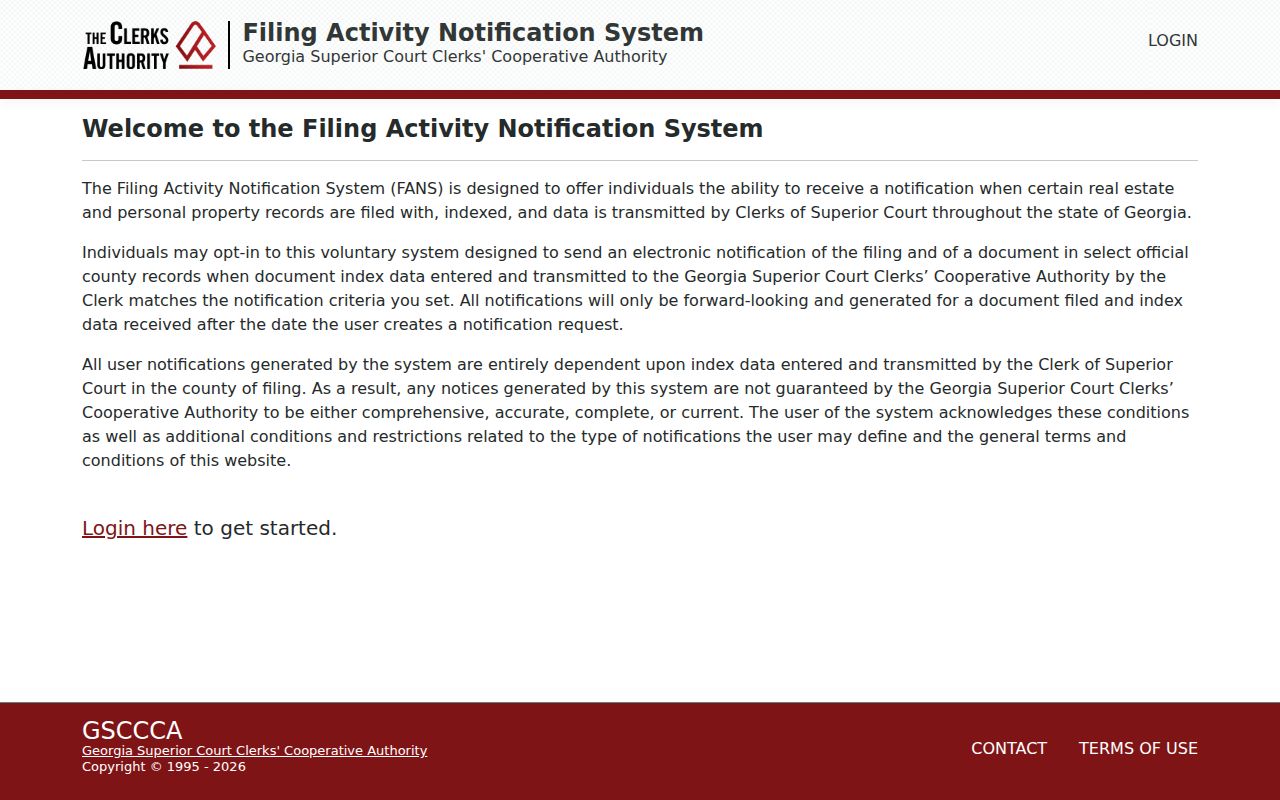
Georgia's GSCCCA Filing Activity Notification System sends free alerts when new filings hit the record. Think of it as a watchdog. It cannot block a recording. It cannot vouch for a deed's validity. It also cannot spare you from checking the deed records yourself now and then. The service runs statewide, and its numbers prove the point. Between 2023 and mid-2024, FANS counted over 56,000 users. It handled 118,000 requests. It also generated some 125,000 matches or alerts by June 30, 2024. Those totals cover all of Georgia, not Miller County alone.
The official FANS registration page shows the sign-up form for these alerts.
Treat each alert as a starting point. Open the actual deed entry, read it yourself, and call the Clerk if a Miller County filing looks unfamiliar.
Request a Miller County Deed Copy
Start with the details that identify the deed itself. Jot down the parties and the instrument type. Add the recording date, the book and page, or the instrument number. GSCCCA may offer the image under its current terms. If it does not, call or visit the Clerk. Say whether an inspection copy, a plain copy, or a certified copy is needed. The Clerk sets different terms for each. Miller County copy fees vary by type. Confirm the price, payment method, delivery options, and counter hours before sending a request.
A written request works best when it includes the exact reference and a return contact. The county open-records form can help route general county material. For constitutional-office records, request the deed copy directly from the responsible office instead.
Recorded, not guaranteed. Miller County deed records show filed instruments, not a legal opinion that title is clear. Unrecorded interests, indexing errors, estates, and competing descriptions may require professional review.
Handle Estates, Trusts, and Entity Names
A clean chain of title can detour through probate, a trust, or a business entity. An executor's or administrator's deed belongs beside the estate authority in the Probate Court file. Trust wording may name a trustee rather than the beneficiaries. Company ownership may call for a Georgia Corporations Division search. That search confirms the entity's exact legal name. Keep in mind that a registered agent is not automatically the property owner.
Search both the person and the fiduciary or entity form. Then let the deed's granting clause and legal description control. Does the chain jump from a decedent straight to an heir or representative? Ask the Probate Court for the estate record that explains the authority. Keep case and recording references separate. A probate file and a deed book are maintained by different offices in Miller County.